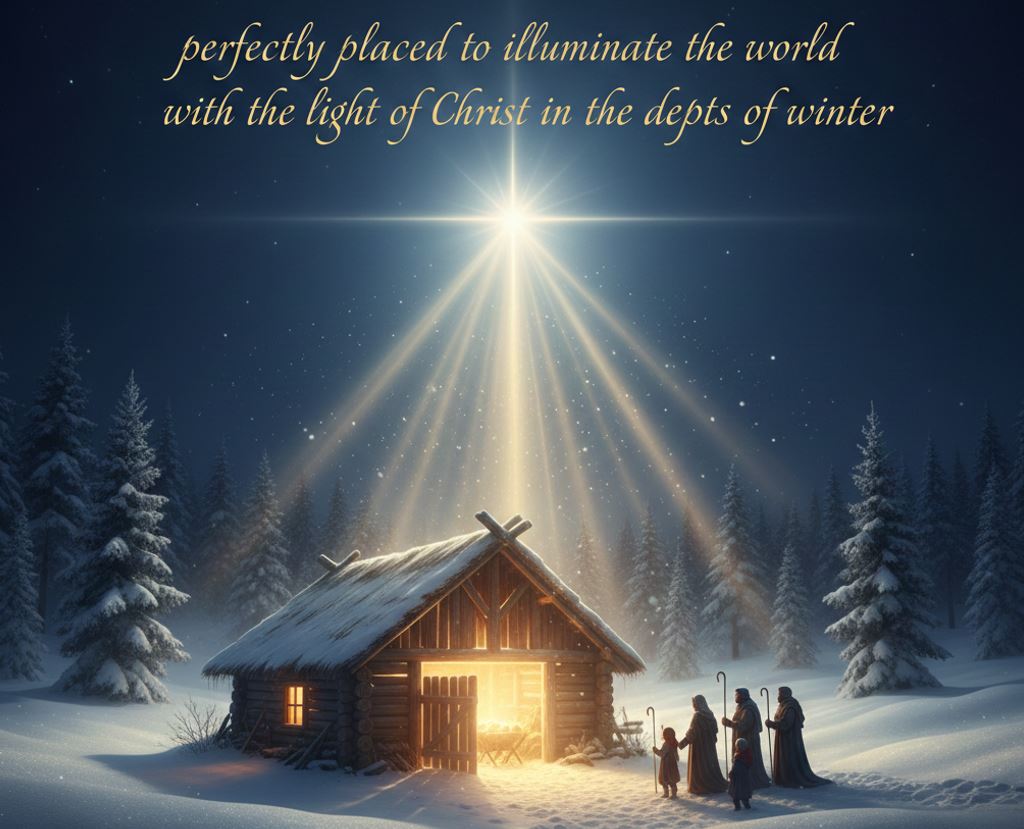
As Anglo-Catholics and those who cherish the Society of Our Lady of Walsingham, we adore the great Christian Feast of the Nativity. Every year, we prepare our hearts through Advent, hungrily awaiting the joyous moment when we sing carols and celebrate the Incarnation of Our Lord. Midnight Mass is a favourite!
But there’s one question that often pops up, perhaps from a curious friend or a searching enquirer: Was Jesus actually born on the 25th of December?
It’s a wonderful question that invites us to look not only at Scripture but also at the rich history and beautiful tradition of the Church. Let’s explore why the answer is both ‘probably not’ and ‘it absolutely doesn’t matter!’
1. The Gospels are Silent
If you open the pages of the Gospels of Matthew or Luke—our primary accounts of Jesus’ birth—you will find rich detail: the stable, the shepherds, the wise men, the star, the angels. What you won’t find, however, is a specific date.
The writers of Scripture were not chroniclers aiming for an entry in a modern diary or historical register. They were concerned with profound theological truths: that God became man, that salvation was offered, and that Jesus was the promised Messiah. The event was everything; the exact time and date were simply not part of the inspired narrative. The shepherds being “abiding in the field, keeping watch over their flock by night” (Luke 2:8, Book of Common Prayer translation) often leads scholars to suggest a spring or autumn time, as winter is typically too cold for shepherds to be out at night, but even this is not conclusive.
2. How the Church Chose December 25th
So, if the Bible doesn’t tell us the date, how did the 25th of December become fixed in the Church’s calendar? There are two main, intertwined historical theories that explain this, both showing the wisdom of the early Church in sanctifying time:
Theory A: The Date of the Annunciation This is perhaps the more theologically satisfying reason. Early Christians were keen to work out the date of the Crucifixion and the Incarnation. By the 3rd century, one highly regarded tradition held that Jesus was conceived on the 25th of March (the Feast of the Annunciation, the day the Angel Gabriel appeared to Mary). If you count forward nine months from the 25th of March, you arrive exactly at the 25th of December. This dating placed the moment of Christ’s Incarnation at the same time He was traditionally believed to have died, reflecting an ancient Jewish idea that great prophets lived an exact number of years.
Theory B: Christianising Pagan Festivals In the Roman Empire, the midwinter period was already a centre of religious celebration. The Romans observed the Saturnalia, and, crucially, the Dies Natalis Solis Invicti—the “Birthday of the Unconquered Sun”—on the 25th of December. As the Christian faith grew, the Church, in its genius, often chose to redeem and redirect existing cultural practices.
By placing the Nativity on the 25th of December, Christians weren’t borrowing a pagan festival; they were asserting a new, profound truth: Christ is the true “Sun of Righteousness” (Malachi 4:2). They simply declared that the Son of God had eclipsed the false worship of the sun god, making the date a triumph of Christian witness.
3. The Event Trumps the Date
Ultimately, for us, whether the date is historically accurate or was chosen for pastoral reasons is secondary. What is absolutely primary is the glorious, eternal truth that we celebrate: The Incarnation.
As we understand through our liturgical life and devotion, Christmas is not merely a historical commemoration; it is the celebration of the eternal Mystery—God becoming man, dwelling amongst us. The Roman Catholic Church Catechism reminds us that “To become a child in relation to God is the condition for entering the kingdom” (CCC 552). The Nativity shows us the humility of God and the sheer depth of His love.
The date is a fixed, helpful point in the year around which the entire beautiful programme of our Christian life revolves. It is the centrepiece of the Christmas season, allowing us to focus our prayer, penance, and thanksgiving on the truth that “the Word was made flesh, and dwelt among us” (John 1:14).
Conclusion
So, while scholarly evidence suggests the Lord was likely born at a different time of year, we, the Church, are right to celebrate His birth on December the 25th. It is a date saturated with liturgical meaning, rich with Christian tradition, and perfectly placed to illuminate the world with the light of Christ in the depths of winter.
It is the fact of the manger, not the date of the diary, that saves us.
If you’d like to delve further into the complex historical dating for this feast, I highly recommend this superbly written article, which covers the detail for this question: How December 25 Became Christmas
0 Comments