What accord has Christ with Belial?

When we provide consecrated space for celebrations of Islamic religious practice and Quranic recitations that deny Christ’s deity, we are not demonstrating love. We are obscuring the gospel, confusing our witness, and prioritising worldly approval over obedience to Scripture and our own ecclesiastical commitments.

“Only say the word”

I write this to myself as much as to you dear reader, as a reminder of the perspective we must take through prayer and study. I write this in order that I may be reminded that Christ is sufficient and in Him all things needed are found, by Him all things existing are sustained and through Him all that I am is saved.

On the beginning of all things

The Christian faith declares that “in him all things hold together” (Colossians 1:17), and modern physics unwittingly testifies to this truth. Matter is far stranger than it appears, with atoms mostly empty space and subatomic particles held together by forces calibrated with breathtaking precision. Science can describe this fine-tuning but cannot explain why it holds. Scripture can: the universe coheres because Christ sustains it by the word of his power.

Come and see!

When Jesus invited people to “come and see,” He offered no programme, no strategy document, and no measurable outcomes beyond the transformation of human hearts. In three simple words, Christ extended an invitation that has echoed through twenty centuries of Christian witness. Perhaps the modern Church, with all its well-intentioned structures and initiatives, needs to recover something of this radical simplicity. What might it mean for our congregations to strip back the layers of institutional complexity and simply invite people to encounter the living Christ, just as Andrew and John did on that first extraordinary afternoon?

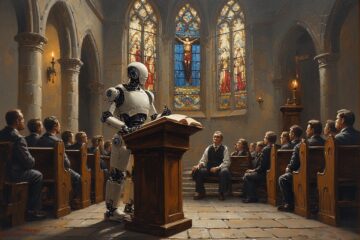
Being Bere-AI-n.

It does seem that in the last year or so the landscape of AI-enabled Christian technology has shifted significantly from experimental early adoption to widespread integration into daily spiritual life and church operations. How should we as Christians approach this rising tide of technology, how do we manage the tension between studying to learn and simply prompting for answers?

The manger calls us to repent and believe

One can sense even more so as we sit here in 2025, a deep longing for peace, a hushed expectancy in homes and churches across the land, an excitement that finds its focus in a single point in human history where a child in a manger in Bethlehem (the โ€˜House of Breadโ€™) born to die, bears the weight of humanity’s sin.