Papally speaking: AI and the nature of humanity

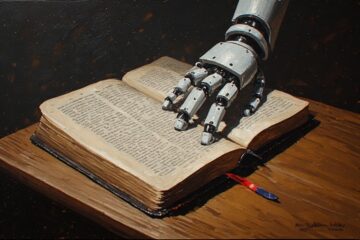
I usually spend my mornings troubleshooting cloud-based document management solutions, navigating AI implementations for clients or wondering why my smart fridge has decided to stage a silent protest against my choice of cold drink, so finding a lengthy papal encyclical on Artificial Intelligence in my inbox was a bit like receiving a system update for my soul.

Finding our way home

In the relentless bustle of modern life, we often find ourselves drifting away from the quiet conversation of prayer. While our humanness creates a sense of distance, the heart of the Gospel reveals a Father who does not wait for an apology but runs to meet us with open arms.

A game of Divine I-spy

Finding Jesus in the Old Testament Reading the Old Testament without looking for Jesus is a bit like trying to assemble a complicated piece of flat-pack furniture whilst ignoring the instructions and the illustration on the box; you might eventually produce something that stands upright, but you will almost certainly Read more

The great Cretan makeover

The heart of the letter to Titus lies in that wonderful assurance that the grace of God has appeared, bringing salvation for all people and training us to renounce ungodliness. We often think of grace as a lovely, soft word, perhaps something we say before a Sunday roast, but St Paul describes it as a tutor or a trainer that helps us grow. In our daily lives, from the kitchen to the marketplace, we are invited to adorn the doctrine of God our Saviour by living with kindness and integrity, making the Gospel look beautiful to a world seeking hope.

Titus 1:2 and the pre-temporal decree

Before the first quark flickered into existence, Godโ€™s salvific plan was already a finished masterpiece. Exploring Titus 1:2 and the outside-of-time-ness of the Creator, we find that our redemption is no divine “Plan B,” but an eternal decree of a God who cannot lie and whose love predates the universe.

Holy sweat and the joyful agony of prayer.

Let us be honest with one another: prayer is often rather harder than the hymnbooks suggest. We have all been there – starting a prayer only to find our minds have wandered to the shopping list. If this sounds familiar, take heart. You are not a failure; you are simply human. In Colossians 4:12, we meet Epaphras, who was ‘always struggling’ in prayer. The Greek word is agonizomai – the root of our word ‘agony’. But this wasn’t mere suffering; it was an athletic contest, a wrestling match in the arena of intercession. Discover why there is profound joy to be found in the holy sweat of persistent prayer…

“Only say the word”

I write this to myself as much as to you dear reader, as a reminder of the perspective we must take through prayer and study. I write this in order that I may be reminded that Christ is sufficient and in Him all things needed are found, by Him all things existing are sustained and through Him all that I am is saved.

On the beginning of all things

The Christian faith declares that “in him all things hold together” (Colossians 1:17), and modern physics unwittingly testifies to this truth. Matter is far stranger than it appears, with atoms mostly empty space and subatomic particles held together by forces calibrated with breathtaking precision. Science can describe this fine-tuning but cannot explain why it holds. Scripture can: the universe coheres because Christ sustains it by the word of his power.

Come and see!

When Jesus invited people to “come and see,” He offered no programme, no strategy document, and no measurable outcomes beyond the transformation of human hearts. In three simple words, Christ extended an invitation that has echoed through twenty centuries of Christian witness. Perhaps the modern Church, with all its well-intentioned structures and initiatives, needs to recover something of this radical simplicity. What might it mean for our congregations to strip back the layers of institutional complexity and simply invite people to encounter the living Christ, just as Andrew and John did on that first extraordinary afternoon?