My dear friends in Christ, this is a question that goes to the very root of our comfort and peace as Christians: If I confess my sins directly to God, am I truly forgiven?
The answer is a resounding, joyful Yes!
This wonderful truth is a central pillar of our Christian faith. If you approach Almighty God with a humble and repentant heart, confessing your sins and putting your complete faith in the atoning sacrifice of our Lord Jesus Christ, you are absolutely, completely, and immediately forgiven.
God’s grace is boundless and, as we rightly affirm, it is mediated solely through our Lord Jesus Christ. It is a grace that is more than sufficient for the pardon of every sin. No human intermediary is required for God to hear your prayer or to grant His divine absolution.
We find this promise beautifully expressed in Holy Scripture, confirming the sufficiency of direct confession to God:
“If we confess our sins, He is faithful and just and will forgive us our sins and purify us from all unrighteousness.” (1 John 1:9)
“For there is one God and one mediator between God and mankind, the man Christ Jesus.” (1 Timothy 2:5)
The moment your heart truly turns to God in Christ and confesses, you are already wrapped in the arms of His inexhaustible mercy.
The Anglican Balance: General Absolution
Understanding this truth is vital to understanding our Anglican heritage.
During the Reformation, Archbishop Thomas Cranmer and his contemporaries intentionally crafted the services in the Book of Common Prayer (BCP) to offer a salve for the troubled conscience of the entire congregation. This was a necessary and deliberate theological catalyzing in the face of widespread abuses—such as the selling of indulgences—and the prevalent doctrine that held that one could only be absolved of mortal sin through the ministry of a priest alone. Literally open the BCP and read the opening pages which denounce the “Popish” false teachings of Rome at that time.
Cranmer’s solution was the General Absolution, used at Morning Prayer (MP), Evening Prayer (EP), and, in a slightly different form, in the service of Holy Communion.
This General Absolution, pronounced by the priest to a penitent congregation, powerfully declares that God pardoneth and absolveth all them that truly repent and unfeignedly believe His holy Gospel. It ensures that every member of the Church who sincerely repents is offered the comfort of verbal pardon, affirming that God’s grace is freely available through faith, without requiring individual private confession for validity.
This goes dead against the Roman Church’s position – the church of Rome withhold general absolution (even though they acknowledge its power)…WHY!? terms and conditions apply? it makes for a good study. But the Anglican position is as though General absolution is perfectly effectual (there are no varying classes of absolution such as “this one only works if XYZ etc…they are all equally effectual (see below BCP modes of absolution)…its as if a king is pronouncing a release order on a load of prisoners in one pronouncement …they ALL walk free.
The Role of Priestly Absolution, Reconsidered
So, if direct confession is sufficient and the General Absolution is available, why, then, do we Anglo-Catholics (and many Christians throughout the centuries) maintain the practice of private, priestly confession and absolution? This is summarised perfectly by the historic Anglican dictum regarding confession: “All may; none must; some should.”
The role of the priest in private confession is not to validate the forgiveness (which God grants directly). Rather, it is a loving, pastoral provision primarily for the assurance of that forgiveness.
From my study into the beautiful writings of the puritans there was one missing link for me which so many of them painfully sort – assurance. And I believe Priestly absolution to be the answer…and then when one evolves as a Christian and trust more and more in the Lord – scriptural reading of Gods forgiveness then becomes enough to quiet the soul.
The Church, in its wisdom and care for souls, offers this special ministry of healing for several reasons:
- For a Troubled Conscience and Assurance: When the soul is deeply burdened by a “weighty matter,” the need to confess our sin out loud and hear the verbal, tangible declaration of pardon often brings a profound peace that private prayer alone cannot settle. As the BCP reminds us, this is an aid for those who “cannot quiet [their] own conscience.” This practice stems from the authority Christ gave His apostles to bind and loose:”Truly I tell you, whatever you bind on earth will be bound in heaven, and whatever you loose on earth will be loosed in heaven.” (Matthew 18:18)
- For Spiritual Counsel: Private confession provides a vital opportunity to receive godly advice and direction from a trusted priest on how to avoid that sin in the future. It helps us to cultivate a deeper path of repentance and amendment of life, a principle we see throughout the Bible:”The way of a fool is right in his own eyes, but whoever listens to counsel is wise.” (Proverbs 12:15)
- A Special Means of Grace (A Sacrament of Healing): It is a visible act of the Church’s minister that seals the invisible act of God’s forgiveness, helping the penitent soul to truly accept the pardon offered by Christ. This communal aspect of healing is also scripturally supported:”Therefore confess your sins to each other and pray for each other so that you may be healed. The prayer of a righteous person is powerful and effective.” (James 5:16)
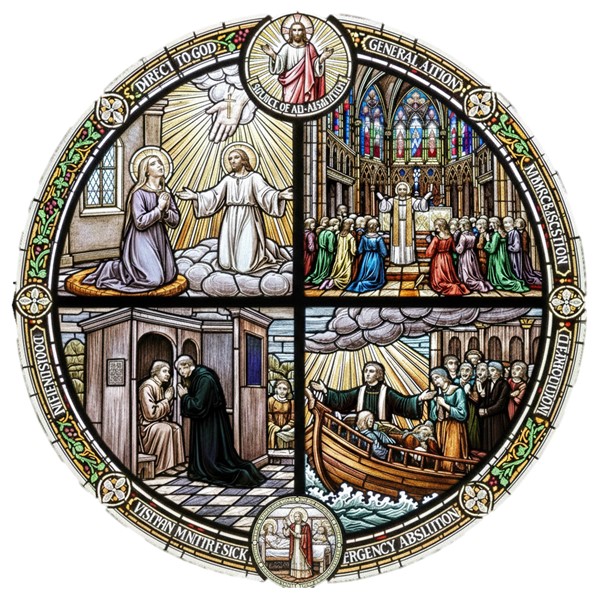
🧭 Five Modes of God’s Absolution
Ultimately, the Church of England has historically, through the Book of Common Prayer and its historic teaching, provides Christians with multiple avenues to access and be assured of God’s forgiveness. We can summarise the five modes of absolution available to us as follows:
- Direct Access to God through Jesus: The fundamental mode of forgiveness, granted instantly upon humble, repentant faith. This is the path of necessity.
- General Absolution from a Priest: The corporate declaration of pardon pronounced over the penitent congregation in the offices of Morning Prayer, Evening Prayer, and Holy Communion (BCP). This is a public salve for the conscience.
- Private Confession to a Priest or discreet and learned Minister of God’s Word: The voluntary, private, and personal hearing of sins, followed by individual ministry of God’s holy Word to receive “the benefit of absolution, together with ghostly counsel and advice, to the quieting of his conscience, and avoiding of all scruple and doubtfulness“. This is an available path of comfort and profound assurance (“some should”).
- Emergency Absolution for the Sick: The specific individual absolution given to the sick or dying, found in the BCP service for the Visitation of the Sick, to offer comfort and peace in extremis. The mode of absolution here in this section of the BCP is to be the standard from of private absolution used in any case.
- Emergency Absolution at Sea: The declaration of General Absolution provided in the Forms of Prayer to be used at Sea (BCP) during times of imminent danger or storm, comforting sailors and those in peril with the immediate promise of God’s mercy.
Be assured, the moment your heart truly turns to God in Christ and confesses, you are wrapped in the arms of His mercy, and the Church provides us with many ways to be comforted by that great truth. Amen.
0 Comments