It’s Not Just Me: The Truth About the Sin That Dwells Within
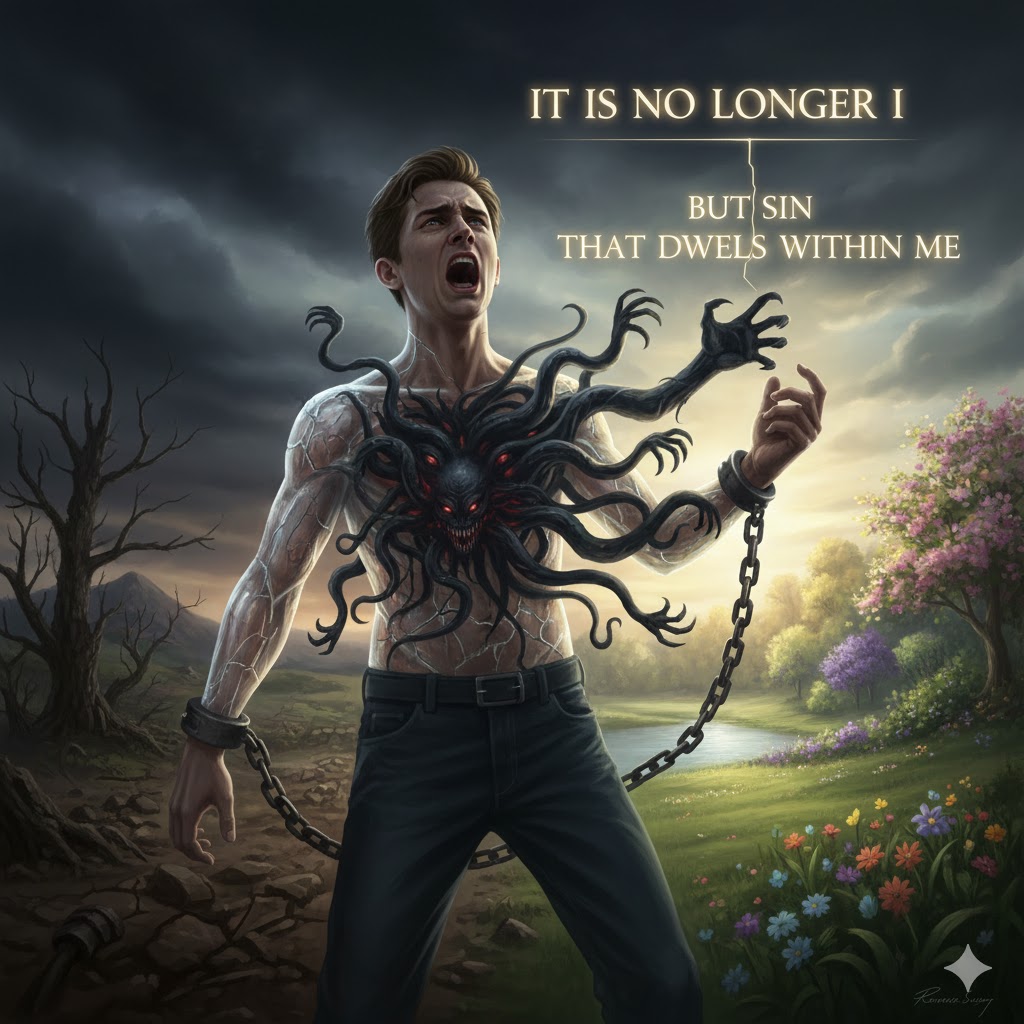
Every Christian who strives for holiness eventually runs headlong into the brick wall of Romans 7. We know what is right, we sincerely desire to do it, and yet, we often find ourselves failing, committing the very sin we despise.
In this chapter, the Apostle Paul provides a diagnosis that is both devastatingly honest and profoundly comforting. Twice he declares:
Romans 7:17: “So then it is no longer I that do it, but sin that dwells within me.”
Romans 7:20: “Now if I do what I do not want, it is no longer I who do it, but sin that dwells within me.”
A plain reading of these verses can stop us in our tracks. Is Paul giving us an excuse? Or is he providing a justified explanation for the unrelenting nature of our struggle?
The answer, found in the tension between these verses and Paul’s own cry of anguish, is one of the most vital truths for the struggling believer.
The Christian’s Honest Plea: An Explanation, Not a License
Many of us live out the following painful scenario:
“I am a Christian, I love Jesus, I love God. I hate my sin. I hate failing God… BUT I keep sinning. The flesh wins many a battle, and I hate it. God doesn’t take the issue away but says, ‘My grace is sufficient for you.’ It is my very nature to sin—that’s not my fault. Adam and Eve were created perfect and they fell; I was born imperfect and I fall. So, I do have a reason (dangerously close to an excuse), and as I have accepted Jesus, He pays for my sins.”
This honest plea perfectly encapsulates the tension of Romans 7. It acknowledges the Causality (the cause) of the sin while still submitting to Culpability (the need for forgiveness).
1. The Diagnosis: Causality (The Cause)
When Paul says “it is no longer I,” he is distinguishing between his intentional, regenerated mind (the “I” who delights in God’s law, verse 22) and the Sin-Principle (the “sin that dwells within”).
This Sin-Principle is the inherited corruption, the powerful, alien force that wages war in our physical members. It is not your fault that this force exists within you; it is the legacy of the Fall—the “law of sin and death.” This is the comforting, honest part of the diagnosis: your struggle is real, it’s not just a weak will; it’s a war against an occupying enemy.
2. The Anguish: Culpability (The Responsibility)
If Paul felt truly excused, the chapter would end right there. But it doesn’t. He concludes with a desperate cry:
Romans 7:24: “Wretched man that I am! Who will deliver me from this body of death?”
The fact that Paul calls himself “wretched” demonstrates that he still accepts personal responsibility for the failure. The “sin that dwells within” is a powerful influence, but the “I” is still complicit in the final, conscious act of yielding. The explanation shows us we are completely helpless to achieve holiness on our own.
Paul’s words are therefore not an excuse; they are an explanation that must lead to despair without a Saviour. They show us that our deepest issue is not just our sinful acts, but our sinful nature.
Approaching the Throne Boldly: The Question of Fairness
The struggle often leads us to ask, “Why was I born into this fallen state? If God knew I would fall, is it not only right that He saves me?”
This desire for fairness is actually a profoundly theological thought. We are saying, “God, look at the deck I was dealt.” The Bible invites this kind of honesty and confidence:
Hebrews 4:16: “Let us therefore come boldly to the throne of grace, that we may obtain mercy and find grace to help in time of need.”
Our boldness is rooted in the fact that Jesus is our sympathetic High Priest—He was tempted in every way, yet without sin. We can come to God with our honest complaints about the inherited nature of sin, knowing He understands.
And this brings us to the glorious truth of the gospel: God’s answer to our “unfair” condition. The plan of redemption was woven into the fabric of eternity, demonstrating that God did not simply react to the Fall. He planned salvation beforehand, fulfilling the requirements of His own justice so that He could be just and the justifier (Romans 3:26).
The Divine Solution: Grace is Sufficient
The core of God’s response to our weakness is not the instantaneous removal of the struggle, but the provision of power within the struggle.
When Paul pleaded with God to remove his own “thorn in the flesh” (a painful weakness), God replied:
2 Corinthians 12:9: “My grace is sufficient for you, for my power is made perfect in weakness.“
This is the great Christian paradox:
- The Diagnosis (Romans 7): The struggle will remain; the sin that dwells within will continue to be a “thorn” and an internal enemy.
- The Deliverance (Romans 8): The power to resist the struggle comes from the Holy Spirit, not our own will-power.
The very moment we rely entirely on Christ, acknowledging our wretchedness and the power of indwelling sin, is the moment Christ’s power becomes most evident in our lives. We are kept in constant, humble dependence on the Saviour.
The deliverance from the despair of Romans 7 is found in the triumphant opening of the next chapter:
Romans 8:1-2: “There is therefore now no condemnation for those who are in Christ Jesus. For the law of the Spirit of life has set you free in Christ Jesus from the law of sin and death.”
This means that while the “sin that dwells within” still exists, it no longer has the final authority over the true Christian. We are set free, not from the presence of the battle, but from the condemnation of failure in the battle.
Jesus Christ also stated clearly during his prayer in the Garden of Gethsemane, moments before his arrest: “Watch and pray that you may not enter into temptation. The spirit indeed is willing, but the flesh is weak.” (Matthew 26:41; also Mark 14:38).
A Call to Action: Rely and Rest
If you resonate with the struggle of Romans 7, remember this:
- You are not alone. Paul described this battle so that you would understand the nature of your enemy.
- The struggle does not define your destiny. Your destiny is defined by Christ’s finished work on the cross.
- Throw yourself at the foot of the cross. It is the only place where the cause of your failure (indwelling sin) is met with the only solution (sufficient grace).
Your only duty is to rely on the Holy Spirit to give you the strength to say “No” to the sin that dwells within, knowing that in Christ, there is no condemnation.
0 Comments