As an AI enthusiast and technology evangelist, I live and work in a space that is ever-changing and evolving. The time I have off between Christmas and New Year is precious “down time” but, technology is SO embedded in our daily lives that sometimes it can be a struggle for me to put down the iPad, and read a physical book rather than a digital copy. This has made me think on my own use of technology within my walk and over this last few weeks I have done a little bit of research (driven by an observation of my own habits) and looked at how AI is becoming an ever-present element of the Christian life. I am working my way through a book (yes, a digital copy) called “The Church Leaders Guide to Artificial Intelligence” by Revd Dr Christopher J Benek and it got me to thinking about how AI will impact us as believers as we move forward into 2026 and beyond.
It does seem that in the last year or so the landscape of AI-enabled Christian technology has shifted significantly from experimental early adoption to widespread integration into daily spiritual life and church operations. According to research by exponential.org:
- General AI usage among church leaders grew from 43% in 2024 to 61% by mid-2025. Specific data shows an 80% year-over-year increase in churches using AI, jumping from 25% in 2024 to 45% in late 2025.
- By late 2025, over 25 million Christians were using AI-powered Bible apps for daily study and prayer. Users reported a 73% increase in daily scripture engagement when using these tools.
And
- Bible Chat, an AI spiritual companion, reached 5 million monthly active users by June 2025, becoming the fastest-growing faith-based app in history.
Even the BBC covered the phenomenon of “Talking to god with AI”.
And I have come across some interesting uses of AI including:
- Bible.ai: This officially launched in app format in February 2025, and features voice interaction and virtual AI for theological dialogue.
- FaithTime AI: Released in late 2025, this platform introduced the “Little Lamb” companion, focusing on personalised daily devotions and habit-building.
- Faith Guide: Emerged as a dominant free alternative to subscription-based AI Bible apps, offering unlimited conversations without ads.
And other offerings including
- “Conversing” with History: There are a range of new apps allow users to simulate conversations with digital versions of historical theologians like A.W. Tozer or Leonard Ravenhill.
- Integration with Non-Christian Tech: Christian creators increasingly adopted general AI tools like Suno AI (which I have used for the song “The Good Shepherd”)for worship music and ElevenLabs for sermon voice generation.
- And a most disconcerting app called “Text With Jesus” which, in their own words allows the users to “Embark on a spiritual journey and engage in enlightening conversations with Jesus Christ, the Apostles, and a multitude of other revered figures from the Bible.”
If you want to have a glimpse at what is available, just head on over to faith.tools and see the myriad apps in the AI category…
This innovation surge of course mirrors what we have seen in our day to day life with AI becoming now so embedded in our daily existence that we scarcely notice it what with Siri, Alexa, Google Assistant and any number of in-car “helpers”. This alas also means we hardly notice the impact it has on us individually or sociologically, from subtle shifts in understanding and world view through algorithmic nudges or echo-chamber curation to wholesale changes in the way we consume and manage our own information input.
There is a quiet shift taking palce which we must be mindful of wherein more and more Christian lives are shaped through apps offering AI-crafted prayer prompts, near instantaneous biblical analysis, and personalised devotional pathways. These tools, from sophisticated study applications to chatbots that suggest scripture or mimic an individual’s response, present a compelling proposition: a faith made more informed, accessible, and intellectually robust through digital assistance, more INSTANT yet somehow LESS knowledgeable.
For many here in the UK church and perhaps beyond, where a positive yet cautious view of technology’s role in human flourishing seems to prevail, these innovations hold genuine promise and yet, as we invite these digital helpers into our spiritual routines we must engage with thoughtful discernment.
We must consider not only what these tools can do for us, but what their pervasive use might be doing to the very fabric of our faith, particularly to our capacity to hear the Holy Spirit and grow in Christian maturity.
The potential benefits of course are significant and align with a scriptural encouragement to love God with all our mind if used to pursue that aim. AI can democratise deep Bible study, a task once requiring extensive libraries and banks of time, it can illuminate linguistic patterns and cross-references across the biblical canon with remarkable speed, acting as a patient tutor for the new believer, the curious sceptic or the time-pressed individual. This can be a powerful aid to the command in 2 Timothy 2:15 to “rightly handle the word of truth.” Similarly, tools that help structure prayer or suggest intercessory topics based on personal journals can serve as a scaffold for a struggling prayer life, providing form where there might be a lack of discipline and offering a kind of technological counterpart to the Spirit’s intercession. For church communities, such tools can also assist with administrative tasks, freeing human resources for more pastoral work.
However, this digital assistance arrives with subtle but profound risks, primarily concerning the process of Christian formation. The first of these dangers lays in the realm of hermeneutics, (or “Herman Newtics” as Homer J would say) which is the interpretation of scripture. An AI (LLM), for all its power, is not a neutral guide much like us as humans because it is shaped by the theological biases, the zeitgeist and weltanschauung present in its training data. For instance, it may present a particular denominational or social view as settled fact, creating an illusion of final, algorithmic authority (and of course the longer the internet is filled with AI-generated content the more it will feed on itself, a sort of theological ouroboros).

This then would run counter to the Berean model in Acts 17:11, where the early Christians were commended for examining “the Scriptures every day to see if what Paul said was true.” Theirs was an active, determined, communal discernment, not a passive reception of a pre-digested answer.
The spiritual muscle of wrestling with a text, of praying for illumination, and of debating its meaning within the body of Christ risks atrophy when the “correct” interpretation is delivered instantly by an impersonal system and presents a very real spiritual “existential” risk.
This then connects us directly to the core issue of spiritual discernment.
Christian growth hinges on learning to distinguish the voice of the Spirit from other voices, as outlined in John 10. Discipleship is a slow, often inefficient process of transformation described in Romans 12:2 as the renewing of the mind. It happens through struggle, patience, and the sometimes-silent work of the Spirit. When an AI tool instantly provides a comforting verse, a precise prayer, or a clear application, it offers convenience that can bypass this necessary struggle.
We may begin to confuse the agreeable output of an algorithm, the “tickling” of our intellectual or emotional ears designed to satisfy and retain us, with the challenging, disruptive, and sanctifying guidance of the Holy Spirit, who leads us into truth and often into difficulty for our growth. Furthermore, to personalise these experiences, tools require data, turning our private doubts, confessions, and petitions into data points which then raises profound questions about the integrity of the confessional space and the vulnerability essential for true spiritual growth.
Ultimately, these individual concerns converge on a threat to the biblical vision of the church. The New Testament is replete with “one another” commands: to love one another, teach one another, admonish one another, and bear one another’s burdens and this is deliberately physical and communal. Hebrews 10:24-25 urges believers not to neglect “meeting together,” but to spur one another on towards love and good deeds. The incarnational reality of sharing bread and wine, of seeing a friend’s weary or anguished face and offering prayer, of the messy but holy work of reconciliation, cannot be replicated digitally.
We see this writ large even now as the enduring legacy of the COVID years. I lost count of the number of Christians who chided me for wanting to continue to meet in person, who said that online church “was the same as meeting in a building” and that perhaps I wasn’t a real Christian because I put meeting together physically ahead of the the new religion of Health & Safety.
During this very odd time, when the church readily acquiesced to the diktat of the state and forsook the meeting face to face, the ZOOM virtual “church” became for many the comfortable church, the church in our homes, on our devices and in being dressed as such, undermined and reduced the perceived enduring value of meeting in person. This was such a sad thing to see and, I know that many who NEEDED the church at that time felt abandoned and deserted but, I digress.
Why share a burden with a fellow believer and be challenged to grow or change when an AI offers judgement-free, instantaneous advice? The convenience of synthetic support can subtly undermine the God-ordained necessity of embodied fellowship. It promotes a privatised faith, whereas the scriptural model is irreducibly corporate. If a whole community relies on the same AI for study, a dangerous homogeneity can set in, stifling the diverse gifts the Spirit gives for the common good.
So how should we as church members, leaders and volunteers proceed? A thoughtful response is not to reject technology outright but to subordinate it to a robust theology of Christian practice.
We must insist that AI remains a tool for information, never the source or means of formation.
Its use must be paired deliberately with the ancient, counter-cultural disciplines that have always nurtured the soul: the silent reading of a paper Bible, the unrecorded prayer walk, the fast from digital inputs – we must practice a kind of sabbath from algorithms, creating regular space for unmediated presence with God and others.
In practical terms, this means using an AI study tool but then discussing its findings perhaps in a small group setting, testing them against scripture and the wisdom of the community. It means allowing an app to prompt our prayer, but then spending time in wordless silence, away from the app cultivating the stillness scripture associates with knowing God. It means valuing the inefficient, personal sermon preparation of a leader over a slick, AI-generated talk, because the process of study is as formative for the preacher as the sermon is for the congregation.

The goal of the Christian life is Christlikeness, a transformation no algorithm can engineer – it is a journey walked in the company of others, through the disciplines of study, prayer, and worship, and in the patient practice of listening for a voice that speaks not from a digital cloud, not from an app, but from the heart of a relational God.
Our task is to ensure our digital tools serve that sacred journey, without ever becoming a substitute for its path.
Semper ad maiorem Dei gloriam
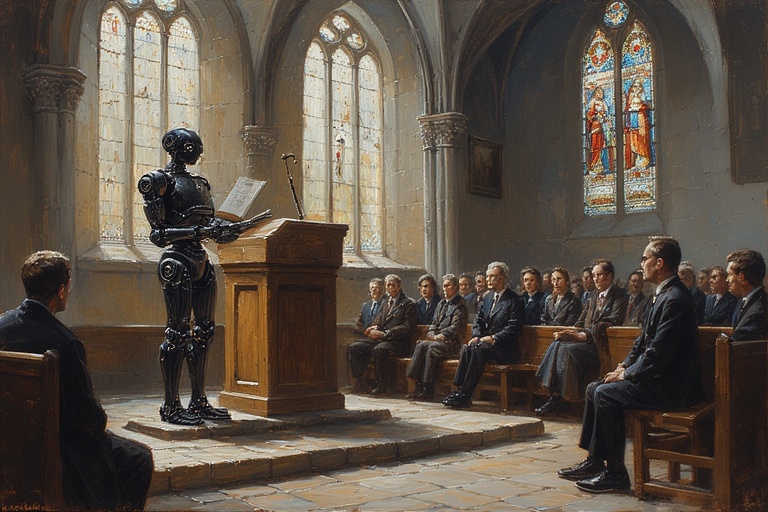
And yes, I DID use AI to create the images the irony is NOT lost on me but some things I cannot do on my own.



0 Comments