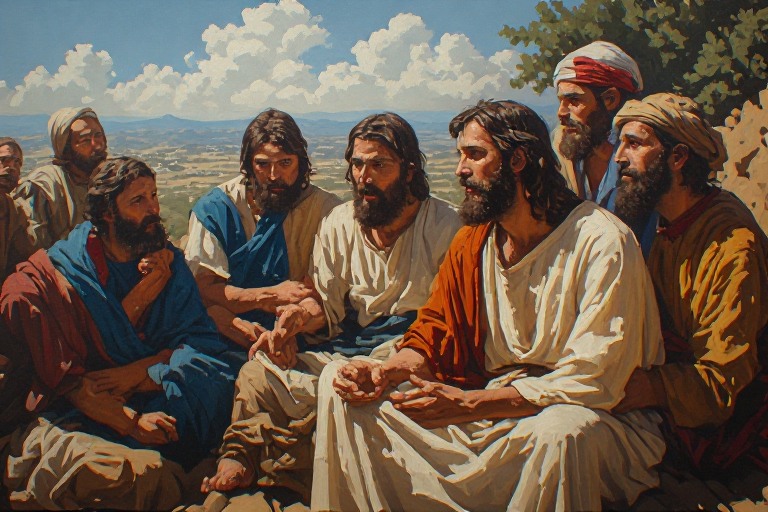
I don’t know about you but when I picture the Sermon on the Mount I often imagine Jesus broadcasting His words to a vast and faceless multitude spread across the Galilean hillside however, a careful reading of Matthew’s Gospel reveals a remarkably intimate setting where Jesus intentionally steps away from the pressing crowds, climbs further up the mountain, and waits for His chosen disciples to approach him. It is to this specific group of men that He opens His mouth to deliver the foundational constitution of His new kingdom. These disciples were an eclectic mix of people who understood the heavy weight of Roman occupation and they had left their nets and their lucrative toll booths, making themselves temporally vulnerable, yet one suspects with surety that they still harboured deep-seated Jewish expectations of a conquering Messiah who would overthrow their political oppressors and grant them positions of tremendous priviledge and power.
“Blessed are the poor in spirit, for theirs is the kingdom of heaven.”
Matthew 5:3 (ESV)
Into this environment of desperate political ambition, Jesus speaks a blessing that entirely subverts their understanding of success by declaring that the kingdom of heaven belongs to the “poor in spirit”. He draws upon the ancient Hebrew concept of the anawim, which described the “bowed down ones” who had no earthly influence and were forced to rely completely upon God for their deliverance. There is a profound duality at work here as Jesus acknowledges the temporal reality of physical poverty, which so often does the hard work of stripping away our illusions of self-sufficiency as some of us will know, while pointing them towards the absolute necessity of a spiritual poverty before God. He is teaching His followers that the kingdom is not taken by political force or moral superiority but is given to those who recognise their utter spiritual bankruptcy and come to the Father with entirely empty hands.
“He who does not know his own emptiness can never know the fullness of Christ.”
Charles Spurgeon
This opening beatitude establishes the grand meta-narrative for the entire Sermon on the Mount, which is not a ladder of moral achievements we must ever climb to earn divine favour but more, it is a mirror designed to reveal our desperate need for grace. The Protestant reformer Martin Luther understood this perfectly when he noted that Christ’s teaching here is meant to “show us our inability, that we may learn to despair of ourselves and seek help elsewhere” (Luther’s Works on the Sermon on the Mount). The Sermon is designed to crush human pride so that divine mercy might rebuild us from the ground up. This theological thread is carried forward by modern Reformed thinkers, with R.C. Sproul reminding us that “to be poor in spirit is to acknowledge our spiritual bankruptcy” (R.C. Sproul on the Beatitudes). We cannot receive a kingdom from Christ until we are willing to admit that we have absolutely no kingdom of our own to offer him in return.
And of course for us navigating the complexities of a modern Christian life, this intimate teaching remains an anchor that holds us steady through the various seasons of our lives. We might find ourselves enjoying great career success, living comfortably in warm houses, and possessing bank accounts that would astound those first-century Galilean fishermen. Yet, even as these temporal blessings are occuring around us, we are called to cultivate that exact same posture of spiritual poverty, to remind ourselves of our desperate need for a Saviour. Whether we are closing a huge deal or simply trying to manage the chaos of a busy family, we must each of us remember that our worldly successes do not add a single ounce to our spiritual standing before a holy God.
We remain entirely dependent on the grace of Jesus, holding our achievements loosely and keeping our hearts humble in the joyful knowledge that he provides the feast for those who bring nothing to the table.
Pax
Shaun
0 Comments