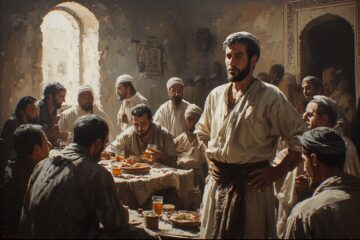
Finding the Kingdom at the end of ourselves

When Jesus stepped away from the pressing crowds to deliver His most famous sermon, He was speaking directly to a small group of disciples whose rough, working-class backgrounds naturally prepared them to understand the harsh realities of worldly poverty. By declaring that the kingdom of heaven belongs to the “poor in spirit”, He brilliantly subverted their expectations of earthly glory, teaching them instead that true spiritual wealth begins with the quiet recognition of our complete moral bankruptcy. This opening blessing sets the tone for everything that follows, acting not as a demanding ladder of moral perfection for us to climb, but rather as a mirror designed to reveal our desperate need for a Saviour.


Disclosure Day: A “Nothingburger” for the soul?

Watching Spielberg’s Disclosure Day, I felt the “spine-tingling” pull of the unknown, but as a reformed anglican, I see a devalued humanity. Is the “Alien Hypothesis” a spiritual diversion? From “nothingburger” UFO files to the elevation of empathy over truth, I explore why our unique place in God’s story remains unshaken by cinematic disclosures.

Papally speaking: AI and the nature of humanity

I usually spend my mornings troubleshooting cloud-based document management solutions, navigating AI implementations for clients or wondering why my smart fridge has decided to stage a silent protest against my choice of cold drink, so finding a lengthy papal encyclical on Artificial Intelligence in my inbox was a bit like receiving a system update for my soul.

Finding freedom in the Father’s gaze

We often treat the sudden exit of Ananias and Sapphira as a terrifying divine audit, yet it is actually the ultimate cure for our modern obsession with spiritual stage-management. Their tragedy was not a matter of a lightened purse but a heavy heart that was far too preoccupied with the fickle applause of the gallery. By pretending to be more holy than they truly were, they missed the profound rest of being fully known by a Father who sees every secret. When we finally stop performatively tidying the cupboards of our souls, we find a love that requires no filters.

Finding our way home

In the relentless bustle of modern life, we often find ourselves drifting away from the quiet conversation of prayer. While our humanness creates a sense of distance, the heart of the Gospel reveals a Father who does not wait for an apology but runs to meet us with open arms.

A game of Divine I-spy

Finding Jesus in the Old Testament Reading the Old Testament without looking for Jesus is a bit like trying to assemble a complicated piece of flat-pack furniture whilst ignoring the instructions and the illustration on the box; you might eventually produce something that stands upright, but you will almost certainly Read more

The great Cretan makeover

The heart of the letter to Titus lies in that wonderful assurance that the grace of God has appeared, bringing salvation for all people and training us to renounce ungodliness. We often think of grace as a lovely, soft word, perhaps something we say before a Sunday roast, but St Paul describes it as a tutor or a trainer that helps us grow. In our daily lives, from the kitchen to the marketplace, we are invited to adorn the doctrine of God our Saviour by living with kindness and integrity, making the Gospel look beautiful to a world seeking hope.

Titus 1:2 and the pre-temporal decree

Before the first quark flickered into existence, God’s salvific plan was already a finished masterpiece. Exploring Titus 1:2 and the outside-of-time-ness of the Creator, we find that our redemption is no divine “Plan B,” but an eternal decree of a God who cannot lie and whose love predates the universe.