“Oh death where is thy sting?”
Then Jesus, crying out with a loud voice, said, Father, into your hands I commend my spirit. And having said this, he breathed his last.
Luke 23:46
I’ve never really delved into the structure of this sentence in Luke before in too much detail but, I want to examine the text a bit more closely in this very off-the-cuff post.
Admittedly, the title is a bit click-baity but, within that there is truth so let’s press on.
Did Jesus die on the cross, for our sins. Absolutely. that is the foundation of the Gospel – Our Lord most definitely died on the cross of Calvary, for the remission of our sins. End of.
And here’s the question: Did the crucifixion KILL Our Lord? Well, let’s explore that in a bit of detail?
The grim reality of crucifixion
Crucifixion was a deliberately slow and public method of execution designed by the Romans to maximize physical agony and humiliation. Before even reaching the cross, victims underwent scourging with a multi-pronged whip embedded with metal and bone, which tore open the skin and muscle. Once at the execution site, five- to seven-inch iron spikes were driven through the wrists and feet, crushing major nerves and initiating a state of profound traumatic shock and non-stop, burning pain.
The physical posture on the cross made breathing a mechanical nightmare. Because the body hung by the arms, the chest muscles were pulled completely taut, locking the lungs into a permanent state of inhalation. To exhale, the victim had to painfully push upward using their nailed feet and pull with their impaled wrists, dragging their raw, whipped back against the rough wood. Eventually, muscle cramping and sheer exhaustion made this impossible.
Aside from breathing failure, the body underwent massive systemic collapse. The severe blood loss from the initial whipping, combined with intense heat and a total lack of water, led to rapid dehydration and hypovolemic shock. This caused blood pressure to plummet and the heart to race uncontrollably. The immense physical stress also triggered fluid retention around the lungs and heart, occasionally leading to fatal cardiac rupture.
Depending on the victim’s physical stamina and the severity of the preliminary scourging, death could take anywhere from several hours to multiple days. It was a weapon of psychological terror, meant to leave the victim exposed to insects, birds, and public mockery until the body finally gave out completely.
To hasten death. Without the use of their legs, victims could no longer lift their bodies to exhale, causing them to suffocate within minutes so their bodies could be removed quickly.
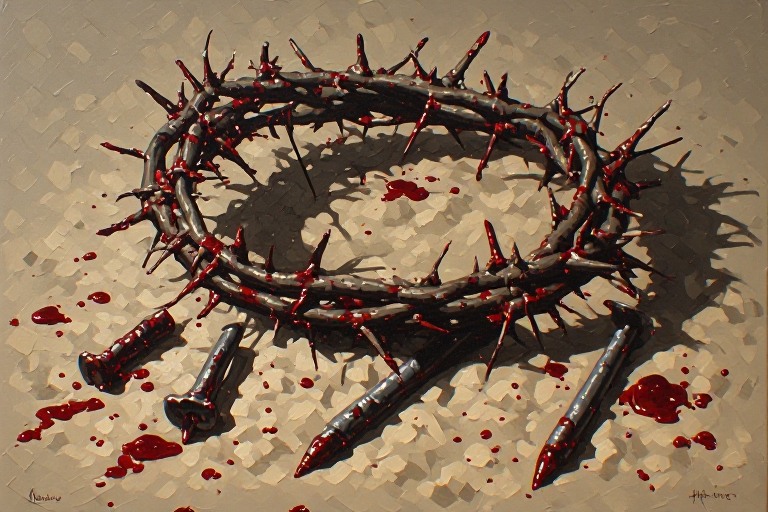
The final act on this side of that side of the resurrection
Then Jesus, calling out with a loud voice, said, “Father, into your hands I commit my spirit!” And having said this he breathed his last.
Luke 23:46
This act, crying out in a loud voice, informs us that Christ did not die by crucifixion, for if He did He would not have been able to call out those words, for He would have no breathe in His body. If crucifixion kills most commonly by asphyxiation and He is at the point of death, then it would be impossible for Christ to cry out in a loud voice as there would be no air in his lungs.
But if crucifixion didn’t kill him, then what did?
HE did, He willingly surrendered himself to death.
You see, Jesus was not simply a good man, He was no mere mystic, He was the very being of God, He was the Creator come low into His creation, He was the potter as clay but, in full control at all times.
I lay it down
No one takes my life from me, but I lay it down of my own accord. I have authority to lay it down, and I have authority to take it up again. This charge I have received from my Father.
John 10:18
This is really important, that Jesus as the creator of the universe, as God, does not have His life ripped away, he is not at the whim of the deceiver, the Romans or the Pharisees, He is in full control at all times. This knowledge should make the gift of His life for us even more wrenching. He LITERALLY gave up His life for us, He didn’t just put Himself in the middle of a process from which he could not escape. Do we not think he could have at any moment called upon legions of Angels to relieve Him and remove Him from the cross? Of course He could but, he CHOSE to lay it down, to give it up, to acquiesce to death to fulfil a legal requirement, a just requirement, a holy requirement.
From John chapter 10 verses 17 to 18:
I lay down my life that I may take it again. No one takes it from me, but I lay it down of my own accord.
Christ surrendered his life, for us, that God might look upon us and see Christs righteousness, even as He looks upon Christ and sees our sin.
0 Comments