Recovering the radical simplicity of Gospel invitation
At church this past Sunday (18/01/26) the sermon was on the baptism of Jesus and focused in on something very interesting and it certainly has had me thinking since then. Five words that hold so much depth that we often fail to examine the layers.
The next day again John was standing with two of his disciples, and he looked at Jesus as he walked by and said, “Behold, the Lamb of God!” The two disciples heard him say this, and they followed Jesus. Jesus turned and saw them following and said to them, “What are you seeking?” And they said to him, “Rabbi” (which means Teacher), “where are you staying?” He said to them, “Come and you will see.” So they came and saw where he was staying, and they stayed with him that day, for it was about the tenth hour. One of the two who heard John speak and followed Jesus was Andrew, Simon Peter’s brother. He first found his own brother Simon and said to him, “We have found the Messiah” (which means Christ). He brought him to Jesus. Jesus looked at him and said, “You are Simon the son of John. You shall be called Cephas” (which means Peter).
John 1:35-42 (ESV)
There is a moment in the first chapter of John’s Gospel that deserves far more attention than it typically receives. John the Baptist has just identified Jesus as the Lamb of God, and two of his disciples begin to follow this One whom their teacher has so dramatically announced. Jesus turns, sees them following, and asks a question that pierces to the heart of all human longing: “What are you seeking?” Their response is almost endearingly awkward, for they simply ask where He is staying, as though they hardly know what to do with themselves now that they have begun to follow Him. And Christ’s reply is an invitation that has lost none of its power across two thousand years: “Come and you will see” (John 1:39, ESV).
In any other conversation, if that were you or I, we would probably respond “Oh, at Bob’s house” or “At the Premier Inn”. The point is, we would have answered the question but Jesus doesn’t do that (and this style his modus operandi) instead, He encourages action, movement and an exercise of calling to DO something not just be given an answer. This is indicative of the calling of Jesus in our lives, to “Come and see”, to come, and see.
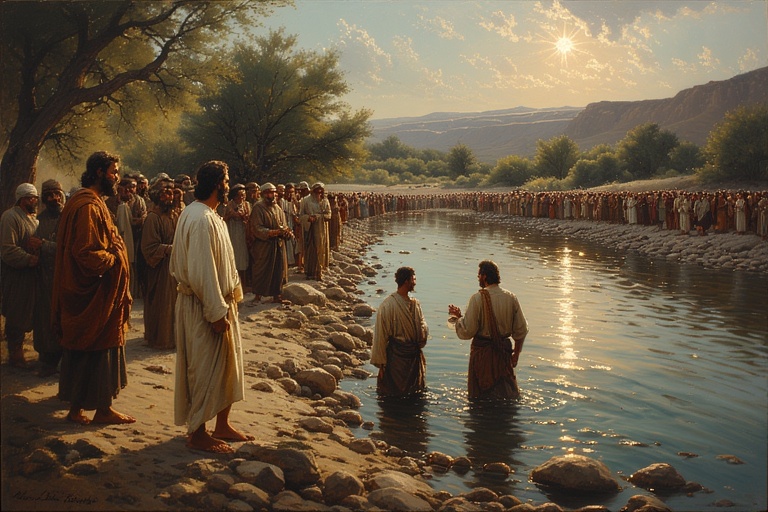
These words contain within them the entire shape of Christian discipleship, for there is no elaborate explanation, no doctrinal examination, no programme of instruction that must first be completed.
There is simply an invitation to come, to see, to abide with Christ and discover through lived experience who He truly is.
The two disciples came and stayed with Him that day, and one of them, Andrew, immediately went to find his brother Simon with the breathless declaration, “We have found the Messiah” (John 1:41). Something happened in that encounter which no amount of prior instruction could have manufactured.
Chrysostom, the fourth-century Archbishop of Constantinople, reflects beautifully on this passage in his Homilies on the Gospel of John. He observes that Christ did not say “I will tell you about my dwelling” but rather invited them to come and see for themselves, “by this bringing them to closer relationship, and showing that He desired them.” The invitation was not merely informational but relational, not simply about conveying facts but about drawing souls into communion with the living God. Chrysostom understood that Christianity is not first and foremost a system to be explained but a Person to be encountered.
This has profound implications for how we understand the task of the Church in every generation. We live in an age that loves expediency, directness and measurement, that feels most comfortable when it can quantify outcomes and demonstrate progress through carefully designed metrics. There is nothing inherently wrong with thoughtful planning or with seeking to be good stewards of the resources entrusted to us, and the Church has always needed some degree of order and structure to fulfil her mission. Yet one wonders whether we have sometimes allowed the scaffolding to obscure the building, whether our programmes and initiatives and strategic plans have become so elaborate that the simple invitation to encounter Christ has been lost beneath layers of process and/or institutional complexity.
The Venerable Bede, writing in the eighth century, noted in his commentary on John’s Gospel that the two disciples who followed Jesus were seeking not merely information about Him but deep down, transformation through Him. They wanted to know where He was staying because they wished to stay with Him, to learn from Him not as students absorbing facts but almost as spiritual apprentices being formed by proximity to their Master. This is the authentic pattern of Christian formation that we find both in Scripture and in the witness of the early Church, a pattern rooted not in programmes but in presence, not in strategies but in the slow work of the Holy Spirit drawing souls ever deeper into the life of Christ.
Richard Hooker, that most judicious of Anglican divines, wrote in his Laws of Ecclesiastical Polity of the danger of multiplying human innovations beyond what the Gospel requires, arguing that the Church’s structures should serve the proclamation of Christ rather than overshadwoing it. Hooker was no enemy of order or ceremony, but he understood that all such things must point beyond themselves to the One whom we worship, when our structures become ends in themselves, when the busyness of church life leaves little room for the contemplative encounter with Christ that transforms hearts, we have lost something essential.
What might it look like for our churches to recover the radical simplicity of “come and see”? Well, it would not mean abandoning all organisation or structure, for the Body of Christ requires coordination to function well. But it might mean asking ourselves whether every programme, every initiative, every meeting truly serves the purpose of helping people encounter Christ, or whether some of these things have simply accumulated over time without anyone quite remembering why they exist. It might mean creating spaces of genuine encounter rather than filling every moment with activity. It might mean trusting that the Holy Spirit is capable of drawing souls to Christ without requiring an elaborate human apparatus to assist Him.
St Augustine of Hippo, in his Tractates on the Gospel of John, reflects on how the disciples who followed Christ were invited into something they could not have anticipated or understood in advance. They had to come and see, to experience for themselves, before they could truly know who Jesus was. Augustine reminds us that faith is not opposed to understanding but rather precedes it, that we must first trust the invitation before we can fully comprehend the One who extends it. This is the pattern of authentic Christian faith rooted in Scripture and tested by centuries of the Church’s experience: we come to Christ not because we have already figured everything out but because He calls us, and in coming we discover more than we could ever have imagined.
To those who follow Christ the call upon us is to examine whether our church communities genuinely embody this invitation or whether we have unintentionally constructed barriers of complexity that make it harder for seeking souls to encounter Jesus, to “see” Him. We are challenged to ask whether our energies are directed toward authentic Gospel witness, grounded in Scripture and the wisdom of the historic Church, or whether we have been distracted by the metrics and methods of a culture that measures success very differently from how God does. Let us be communities that say, with all the simplicity of our Lord’s first invitation, “Come and see.”
To those who are seeking, who perhaps stand at the edge of faith wondering whether Christianity has anything to offer the invitation that Jesus extended to those first disciples is the same invitation He extends to you today. You do not need to have everything figured out before you come. You do not need to pass an examination or complete a course. You are simply invited to come and see, to encounter for yourself the One who has been drawing your heart toward Him, prehaps for longer than you realise. Come and see. Stay a while. And discover what Andrew discovered: that in Jesus Christ, we find not merely a teacher or a guide but the Messiah, the Saviour, the One for whom our hearts have always been longing.
The Gospel is gloriously, radically simple. It is the invitation to come to Christ and find in Him forgiveness, transformation, and eternal life. May our churches be places where that invitation rings out clearly, uncluttered by unnecessary complexities that we so easily (and perhaps comfortingly) accumulate. May we learn again to say, as our Lord said to those first seekers by the Jordan just simple, “Come and you will see.”
Laudetur Jesus Christus!

0 Comments