As the days grow short and the year turns towards its end, our thoughts and our liturgies naturally and inevitably drift towards that small Judean town whose name echoes through the centuries. We picture a stable, a star, a mother and her child. Yet within that familiar scene lies a deeper, more nourishing narrative waiting to be traced, a trail of meaning that leads from ancient grain fields to the very heart of our worship.
It is a trail that begins, as all good stories do, with a name. Bethlehem, in the Hebrew, is Beth Lechem – the ‘House of Bread’. Now, this was not mere poetry oh no, the surrounding hills were fertile grain-producing land making this little town a literal breadbasket for the region. And in the beautifully coherent logic of scripture, where physical realities so often prefigure spiritual truths, this humble fact becomes the first clue in a divine mystery. The story of God’s provision, it seems, is meticulously signposted, and our Anglican tradition, with its cherished three-fold cord of scripture, tradition, and reason, is wonderfully equipped to follow the breadcrumbs from prophecy to fulfilment and finally to our parish altar.
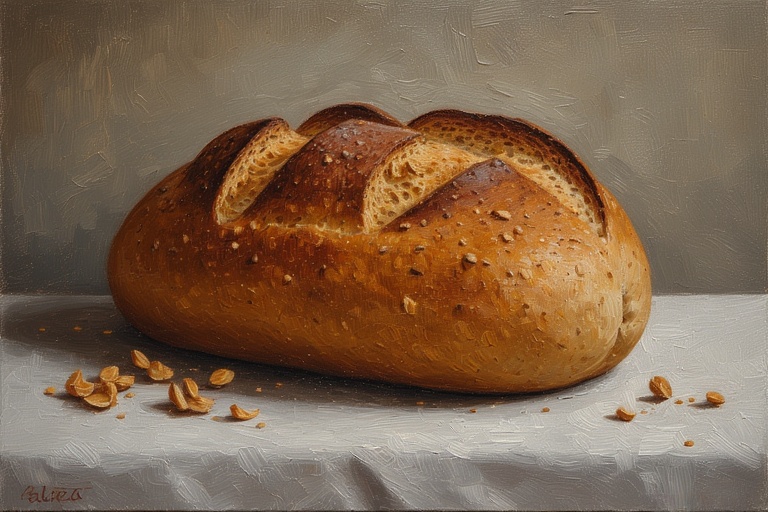
The trail does not start in a manger, however, but in the rustling fields of the barley and wheat harvest. Long before it was associated with a star, Bethlehem was a place of providential sustenance. Its most famous pre-Christian story is that of Ruth, the Moabite widow who comes with her mother-in-law Naomi to Bethlehem, famously arriving “at the beginning of barley harvest.”
So Naomi returned, and Ruth the Moabite her daughter-in-law with her, who returned from the country of Moab. And they came to Bethlehem at the beginning of barley harvest.
Ruth 1:22
It is in these Bethlehem fields that she gleans for survival and finds not only bread but a future in the person of Boaz, a kinsman-redeemer. Their union secures her place in the community and, in a stunning theological twist, in the lineage of King David, for Bethlehem’s next great chapter is indeed a royal one.
The prophet Samuel anoints the young shepherd David, “the son of an Ephrathite of Bethlehem in Judah,” as king over Israel.
Now David was the son of an Ephrathite of Bethlehem in Judah, named Jesse, who had eight sons. In the days of Saul the man was already old and advanced in years.
1 Samuel 17:12
From this unassuming ‘house of bread’ comes the shepherd-king who will feed and lead His people. This dual identity both as a place of foundational provision and Davidic origin crystalises in the prophecy of Micah, who declares,
But you, O Bethlehem Ephrathah, who are too little to be among the clans of Judah, from you shall come forth for me one who is to be ruler in Israel.
Micah 5:2
The stage is now irrevocably set and the ‘House of Bread’ is destined to produce a ruler of ancient lineage, one who would, in a sense, feed God’s flock.
Centuries of unbearable silence pass until a Roman decree sends a man of David’s line back to his ancestral town. The evangelists Matthew and Luke, writing with great theological precision go to great pains to anchor Jesus’ birth in this specific geography. Matthew directly quotes Micah, seeing in the bureaucratically enforced journey a divine hand fulfilling an ancient promise.
They told him, “In Bethlehem of Judea, for so it is written by the prophet:
6 “‘And you, O Bethlehem, in the land of Judah,
are by no means least among the rulers of Judah;
for from you shall come a ruler
who will shepherd my people Israel.’”Matthew 2:5-6
Luke, too, carefully notes Joseph’s Davidic roots and their reason for travelling to Bethlehem.
And Joseph also went up from Galilee, from the town of Nazareth, to Judea, to the city of David, which is called Bethlehem, because he was of the house and lineage of David,
Luke 2:4
This is therefore no arbitrary location for the incarnation more, it is a deliberate and meaningful act within a pre-written narrative. The child laid in a manger – a feeding trough likely hewn of stone in the ‘House of Bread’ is the ultimate convergence of symbol and substance.
The physical sign and the spiritual reality meet in the vulnerable person of the Christ.
The One whom the Gospel of John would later reveal as the ‘true bread from heaven’ makes His entry into our world in the one town whose very name heralds His mission. The manger becomes the first altar, holding not ordinary food but the one who would offer himself as sustenance for the life of the world.
This trajectory from prophecy to person finds its powerful explication in the teaching of Jesus himself, which in turn forms the bedrock of our sacramental life. In the sixth chapter of John’s Gospel, after the miraculous feeding of the five thousand, Jesus delivers His profound ‘Bread of Life’ discourse. He tells the crowd:
Jesus said to them, “I am the bread of life; whoever comes to me shall not hunger, and whoever believes in me shall never thirst.
John 6:35
He further clarifies:
I am the living bread that came down from heaven. If anyone eats of this bread, he will live forever. And the bread that I will give for the life of the world is my flesh.”
John 6:51
This is the ultimate revelation of Bethlehem’s meaning.
The town’s name was a clue, a prophetic echo waiting for its fulfilment. Jesus is the true and living bread from the ultimate house of bread. This teaching, so central to our Christian understanding, resonates deeply within the liturgical rhythm of Anglican worship.
The theology woven into the Book of Common Prayer’s service of Holy Communion draws directly from this well. In the prayer of humble access, we ask that we may “so eat the flesh of thy dear Son Jesus Christ, and drink His blood… that we may evermore dwell in Him, and He in us.” The bread we break and share is not a mere symbol of remembrance but it is the means by which, through faith and the Spirit’s grace, we partake of that one true bread. The trail that began in Bethlehem’s fields thus leads directly to the wooden rails of our parish altars, where the bread of life continues to be offered to a hungry world.
So, as we stand on the brink of Christmas, with this narrative of nourishing grace traced out before us, the sentimentalised stable scene gains a profound and grounding depth. That first Christmas was not a random act of holy poverty but a deliberate insertion of divine life into the human story, a fulfilment centuries in the making.
Indeed, the ‘House of Bread’ welcomed the very Bread of Life, the Creator of the Universe so, this Christmas, when you see a nativity scene or hear the name Bethlehem sung in carols, remember the trail across time, remember Ruth’s gleaning of provision, David’s anointing for leadership, and Micah’s pinprick of light in the darkness and with great joy, see it all converging on that Christ child in the manger, who was from the very location of His birth, declaring His mission, His will to be our sustenance.
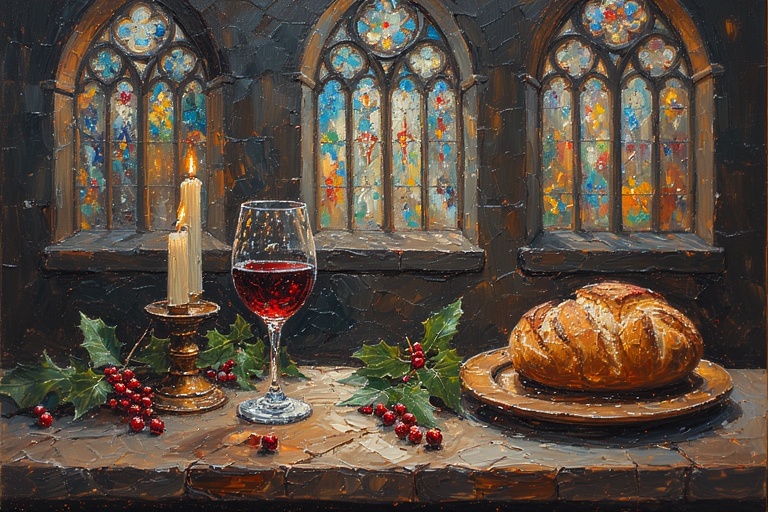
In the simple act of taking bread in the Eucharist at Christmas (and other times) we complete the circle, we are not just recalling a birth but receiving the life that was born just there, just then. So this Christmas season, may you find your own hunger met in the true bread from heaven and may the profound truth that God’s greatest gift was placed in a manger, in the ‘House of Bread’ remind you that His provision is always perfectly prepared, steadfastly faithful, and deeply, endlessly nourishing for the journey ahead.
Fēlīcem Nātīvitātem Dominī

2 Comments
Val F · 12/20/2025 at 3:56 PM
Liked this + thought it summed up the Christmas story extremely.
S1E2: The Christmas One. – Titus One Nine · 01/02/2026 at 2:33 PM
[…] David is tied up at work with a heavy finish to the year before he moves on to a new adventure working for another organisation as well as his own business (https://www.daparkinson-consulting.co.uk/) so we haven’t been able to get together to record a show as we had hoped so, instead we take a look at Bethlehem and how its place in the story of redemption was written long ago. (https://titusonenine.org/breadcrumbs-from-bethlehem-to-the-messiah/) […]