At our church a few of us have been working our way through the book of Esther week by week. You’ll be familiar with the story that chronicles the harrowing yet wonderfully orchestrated tale of a young Jewish exile who becomes queen of the Persian Empire just in time to thwart a genocidal plot engineered by a deeply insecure royal official. Although God is never explicitly mentioned in the text, His unseen hand is abundantly clear as He manoeuvres unalterable royal red tape and a timely bout of royal insomnia to transform a decree of certain death into a joyous festival of deliverance for His people.
We recently finished our study of Chapter 8 and, whilst an hour is barely long enough to scratch the surface of this chapter, I wanted to write down some of my observations and insights as much to preach to may self as to share with you.
Now, when the curtain falls on the seventh chapter of Esther, we witness the spectacular and sudden downfall of Haman, the great adversary of the Jewish people. We might naturally expect the story to end right there with a triumphant feast and a peaceful fade into the sunset, but life is rarely so neat and tidy. While the architect of the evil plot had been decisively removed from the picture, the terrible machinery of his wicked decree was still rolling forward across the one hundred and twenty-seven provinces of the Persian Empire. Ancient Persian law had a rather frightening quirk, which was that any edict stamped with the king’s signet ring could never be revoked. It is a bit like trying to cancel a modern gym membership; the bureaucracy is designed to be entirely unyielding.
This legal predicament provides us with a magnificent and sweeping allegory of the Gospel of Jesus Christ, particularly concerning the profound relationship between the Law and Grace. The unalterable Persian decree of death is a striking picture of the reality of human sin and the spiritual law that dictates the wages of sin is death. God, being perfectly just, cannot simply pretend that this spiritual law does not exist, and the sentence of death hangs over humanity just as surely as Haman’s decree hung over the Jews. However, the grace of God does not simply ignore the demands of justice, but rather provides a superior and life-giving law that completely overcomes the sentence of death.
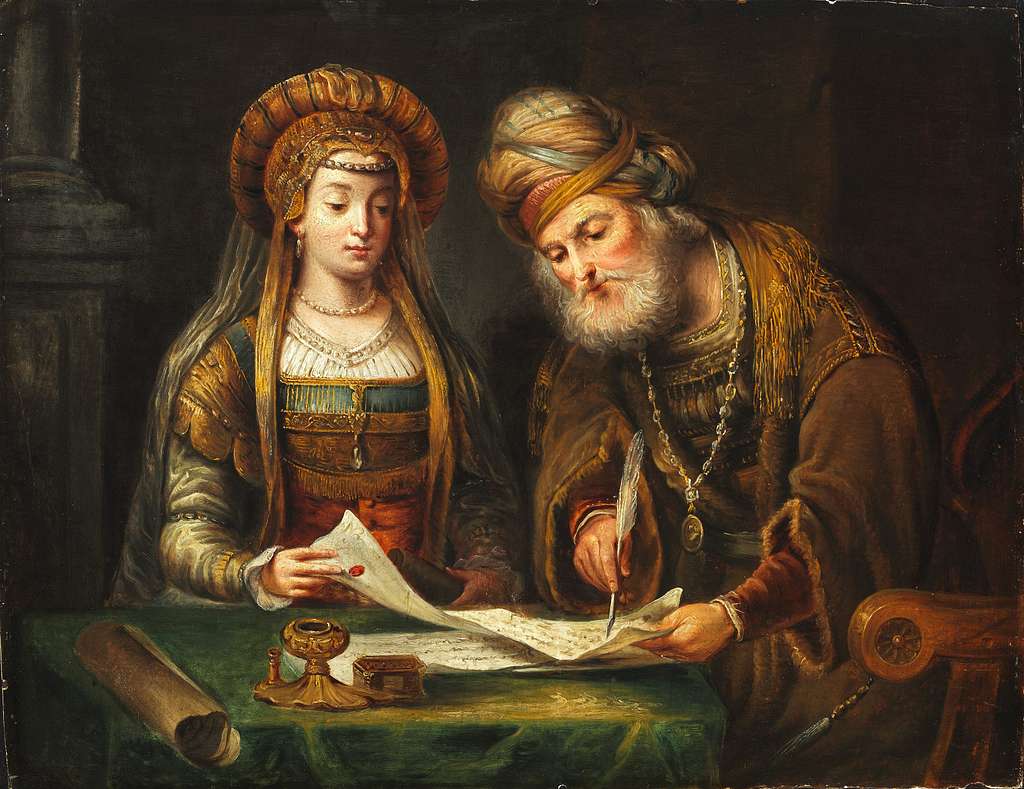
One might assume that with Haman gone and his vast estate safely secured, Queen Esther would simply sit back and enjoy her royal life in the palace. Yet, she falls at the king’s feet, weeping and pleading with him to avert the evil plan that was still active in the provinces. Esther is entirely unwilling to accept personal safety if it means the ruin of her spiritual family, serving as a beautiful model of Christlike intercession for the vulnerable. Her tears lead to a glorious transfer of authority when King Ahasuerus gives his signet ring to Mordecai, allowing him to write an entirely new law.
This new decree does not erase the old one, but it grants the people the royal backing to overcome their enemies and live. Through His victory on the cross and His glorious resurrection, Jesus issues exactly this kind of triumphant counter-decree. As Saint Paul reminds us in Romans 8:2 (ESV),
“For the law of the Spirit of life has set you free in Christ Jesus from the law of sin and death.”
As the royal couriers ride out in absolute haste on the king’s best horses to deliver this joyous news, the text tells us that the Jewish people experienced Orah, a wonderful Hebrew word translated simply as light. It carries the specific idea of the breaking of dawn after a long and terrifying night. For those of us who appreciate the profound beauty of our Evensong services, this word brings to mind that exact moment when the candles are lit in the fading dusk, declaring boldly that the light of Christ can never be extinguished by the darkness of this world.
We do not need to walk through our days with the heavy, fearful posture of the condemned. Instead, we are invited to step into that very same warm light today, trusting completely in the saving work of our Great Advocate, whose service is perfect freedom.
0 Comments